Projects — In development
Iron Famine: A Blacksmith's Tale
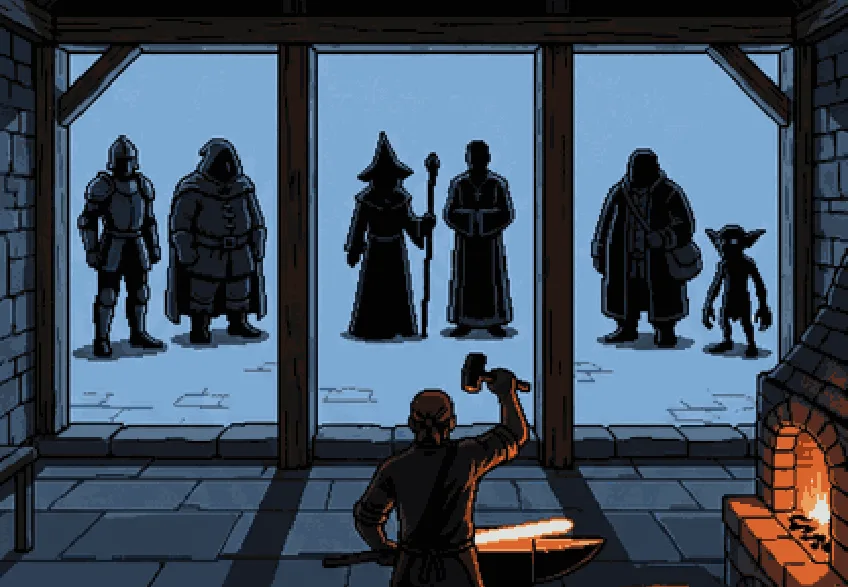 In development
Game demo poster
Iron Famine: A Blacksmith’s Tale
A isometric economic tycoon with RPG progression, set in a fantasy town slowly starving for metal. You keep the last working forge on your street. Everyone wants what comes off your anvil: the watch, the outlaws, and every customer through your door. And there is not enough iron to go round.
The forge
Ore goes into the smelter, bars onto the anvil, and what comes off is decided by your hands. Forging is a three-phase timing mini-game (heat, hammer, quench) and each phase scores; together they set the piece’s quality from 0 to 100. Good work sells. Excellent work is what a contract asks for by name.
Quality is not the whole story. A finished piece can carry a hidden trait: a blade that holds an edge, a helm with a flaw in the crown. The buyer finds out before you do. Sell brilliant work and your name travels; sell junk and the customers with money stop walking in.
The blight. Metal from a sick seam looks like metal. It smelts, it forges, and it fails. Corruption is inherited down the whole chain, from the ore to the bar to the blade, and learning to spot it before it reaches your customers is a skill the game expects you to earn.
The shop
Two ways to sell, and they are not the same business.
- The contract board posts named commissions that DEMAND a grade. Meet it and the premium is real; miss it and you have made an expensive thing nobody ordered.
- The counter takes whatever you put on it. Walk-in customers have their own tastes, their own patience, and their own opinions about your prices.
The day is thirty real minutes long. Between the two, you also owe the town its tax on your turnover, your crew their wages, and yourself a night’s sleep. Every action at the forge costs stamina, and a smith who works past his limit collapses.
The crew
You do not have to do it all by hand. Goblins can be hired, fed, paid and, if you neglect them, lost:
- Miners work the seams outside town and haul what they find to your racks.
- A shopkeeper minds the counter while you are at the anvil, and takes his cut of every sale he serves.
- An apprentice works the anvil on his own, filling a queue you set.
They have traits, they get hungry, and a crew left unpaid stops working before it leaves.
The iron famine, and who profits from it
Two powers are fighting over what is left of the metal, and you supply both.
- The City Guard wants the trade regulated, the ledgers straight, and your storeroom open to inspection.
- The Rogue Brotherhood wants the shipments that never reach the guard’s warehouses, and pays for work with no name on it.
Standing with a faction is a single number, and it cuts both ways. Rise with one and you unlock its ranks, its skills and its rates. You also invite the other’s attention:
- Work with the outlaws and the watch comes to your warehouse: a corporal and two men, a fine taken as a share of your purse, stock confiscated off the racks, and, if they find the wrong thing, an arrest.
- Side with the guard and the Brotherhood comes at night: gold gone, racks emptied, a corner of the warehouse burnt, and sometimes one of your goblins dead on the floor.
The quests are not fetch quests
Each faction’s chain is played, not clicked through. You will sort a batch of blades by the sound they make with five listens for twelve blades. You will argue a treasurer down over the purchase price of your work, with two meters running and one wrong push turning the whole act against you. You will read a coal store’s floor by daylight, work out which way out a thief used last night, and lay one trap and one trip bell on your answer, and then watch him walk.
Finishing a chain grants a rank, a skill point, and a permanent change in how that faction treats you.
Progression
- Ranks with both factions, each unlocking its own skills and standing perks.
- A mastery tree in three lines, where every step you take closes another: what you practise gets faster and cheaper, what you neglect stays hard.
- Shop upgrades, where a better anvil lifts the ceiling on what your best work can be, and new stations open up what you are allowed to make at all.
- Four save slots, an autosave every morning, and a ledger that tells you exactly where the day’s money went.
What ships when
Demo: Winter 2026. The full crafting and economy loop, the goblin crew, the blight, and the first two ranks of both faction chains: the City Guard and the Rogue Brotherhood.
Full release: Summer 2027. Four faction questlines, adding the Church and the Mages’ Academy to the two above.
After that. Trade Clans and Goblin Tribes.